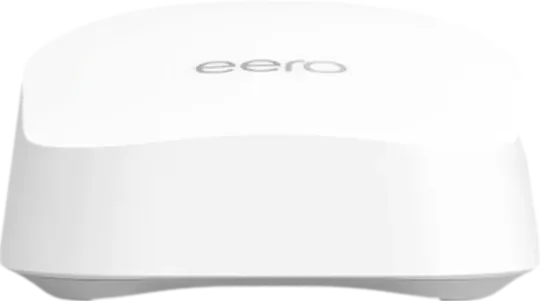
Amazon Eero 7 vs TP-Link Deco BE75: which is better?

Add a third product

Winner: TP-Link Deco BE75

Wins 2 of 4 areas

Who should buy the Eero 7?

  • Stronger features
  • Stronger general info
  • Beamforming: Yes

Who should buy the Deco BE75?

  • Stronger performance
  • Stronger security
  • Wi-Fi speed: 11,530 Mb/s

Who leads by area

Area score out of 100: how close each product is to the best value in every spec, weighted by how much buyers care.

Eero 7Deco BE75
  • 92 General info 90
  • 70 Performance 100
  • 85 Security 100
  • 96 Features 93
  • Wi-Fi speed Important
    Eero 71800 Mb/s Deco BE7511,530 Mb/s
    ×6.4 vs Eero 7
  • LAN ports
    Eero 71 Deco BE752
    ×2 vs Eero 7
  • Wi-Fi bands Important
    Eero 7Dual-band Deco BE75Tri-band
  • Beamforming Important
    Eero 7Yes Deco BE75No
  • Volume
    Eero 71081.6 cm³ Deco BE753866.6 cm³
    −2785 cm³ vs Deco BE75
  • DoS protection
    Eero 7No Deco BE75Yes

Best prices

Prices are updated daily and may differ from the shop. We may earn a commission from purchases.

Amazon Eero 7from $144
TP-Link Deco BE75

Overview

Why is it better?
Amazon Eero 7 wins in 4 specs
  • Beamforming
    Yes
    vs No
  • Volume
    1081.6 cm³
    vs 3866.6 cm³
  • Height
    64 mm
    vs 236 mm
  • Matter
    Yes
    vs No
TP-Link Deco BE75 wins in 12 specs
  • Wi-Fi speed
    11,530 Mb/s
    vs 1800 Mb/s
  • LAN ports
    2
    vs 1
  • Wi-Fi bands
    Tri-band
    vs Dual-band
  • DoS protection
    Yes
    vs No
  • Quality of Service (QoS)
    Yes
    vs No
  • L2TP Passthrough
    Yes
    vs No
  • Network Services Filter
    Yes
    vs No
  • Port filtering
    Yes
    vs No
All specifications side by side
Comparexo score
5.0
Overall score
5.6
Winner
General info
Performance
Security
Features

6.4 points
4.9 points
6.9 points
7.5 points
4.1 points
5.5 points
10.0 points
7.5 points

Connection

What matters most

No differences in this section

Wi-Fi version
Wi-Fi 7 (802.11be), Wi-Fi 6 (802.11ax), Wi-Fi 5 (802.11ac), Wi-Fi 4 (802.11n)

General info

Specifications

No differences in this section

LAN ports
1
2
WAN ports
1
1
Outdoor capability
No
No
USB ports
0
0
Operating power consumption
21.9 W
Unknown
Release date
26 Feb 2025
24 May 2024
Warranty period
1 years
1 years
Weight
608 g
Unknown
Thickness
130 mm
128 mm
Width
130 mm
128 mm
Height
64 mm
236 mm
External antennas
0
0
Internal antennas
Unknown
6
Removable antennas
No
No
Volume
1081.6 cm³
3866.6 cm³

Performance

Specifications

No differences in this section

Wi-Fi version
Wi-Fi 7 (802.11be), Wi-Fi 6 (802.11ax), Wi-Fi 5 (802.11ac), Wi-Fi 4 (802.11n)
Wi-Fi bands
Dual-band
Tri-band
Wi-Fi speed
1800 Mb/s
11,530 Mb/s
RAM
1 GB
Unknown
External memory slot
No
No
DNS relay
Yes
Yes
Internal storage
4 GB
Unknown
Total clock speed
4 × 1.1 GHz
Unknown

Security

Specifications

No differences in this section

Built-in network firewall
Yes
Yes
DoS protection
No
Yes
Wi-Fi security protocols
WPA3, WPA2
WPA3, WPA2, WPA
MAC address filtering
Yes
Yes
L2TP Passthrough
No
Yes
IPsec Passthrough
Yes
Yes
SPI intrusion protection
Yes
Yes
URL filter
Yes
Yes
Network Services Filter
No
Yes
Port filtering
No
Yes
Network Address Translation (NAT)
Yes
Yes
PPTP server
No
Yes
Static IP address
Yes
Yes
Parental control
Yes
Yes
PPTP Passthrough
Yes
Yes
Automatic IP
Yes
Yes

Features

Specifications

No differences in this section

IPv6 enabled
Yes
Yes
Beamforming
Yes
No
Mesh Wi-Fi
Yes
Yes
Matter
Yes
No
MU-MIMO
Yes
Yes
VLAN tagging
Yes
Yes
WPS button
No
Yes
Dedicated smartphone app
Yes
Yes
Wireless
Yes
Yes
DLNA certification
No
No
Universal Plug and Play (UPnP)
Yes
Yes
Quality of Service (QoS)
No
Yes
Dynamic routing
Yes
Yes
Inter-VLAN routing
No
Unknown
Network Time Protocol enabled
Yes
Yes
Static routing
Yes
Yes

Winner: TP-Link Deco BE75

TP-Link Deco BE75 is better in 2 of 4 areas: it leads on the specs buyers care about most, and by a wider margin.

Wi-Fi speed ×6.4

11,530 Mb/s vs 1800 Mb/s

LAN ports ×2

2 vs 1

Wi-Fi bands

Tri-band vs Dual-band

DoS protection

Yes vs No

Quality of Service (QoS)

Yes vs No

L2TP Passthrough

Yes vs No

Network Services Filter

Yes vs No

Port filtering

Yes vs No