6.5
Game controllers

Turtle Beach Afterglow Wave

Write a review
Compare
Power
  • Analog Thumbstick type
  • USB Connection type
Add to comparison

About the model

The Turtle Beach Afterglow Wave is a wired game controller for Xbox and PC, released in 2025.

Its analog thumbsticks use an asymmetrical layout, and sixteen buttons include rear paddles that can be remapped. Hall effect triggers resist wear, while dual force feedback motors respond to in-game events. Four onboard memory profiles store button layouts, and a 3.5 mm jack takes a headset. Power comes through the USB cable, and the controller weighs 300 g.

Overview

Design
Buttons
Features
Power & Connectivity
Why Turtle Beach Afterglow Wave is better than average
  • Release date
    18 May 2025
    better than 87%
  • Width
    120 mm
    better than 92%
  • Onboard memory profiles
    4
    better than 90%
All specifications

Often compared with

7.8
Compare
To favorites
7.1
Compare
To favorites
6.5
Compare
To favorites
6.9
Compare
To favorites
5.4
Compare
To favorites
6.5
Compare
To favorites
6.7
Compare
To favorites
6.3
Compare
To favorites
5.3
Compare
To favorites
6.6
Compare
To favorites

Design

Specifications
Joystick positioning
Asymmetrical
Textured triggers/bumpers
No
Controller weight
300 g
Width
120 mm
Height
160 mm
Thickness
65 mm

Buttons

Specifications
Number of buttons
16
Paddle buttons
Yes
Button mapping
Yes
Thumbstick type
Analog
Hall effect triggers
Yes
Interchangeable thumbsticks
No
Adaptive triggers
No
Integrated touchpad
No

Power & Connectivity

Specifications
Power type
Cable-only
Connection type
USB
Compatibility
Xbox, PC

Features

Specifications
Gyroscopic aiming
No
Charging dock
No
Release date
18 May 2025
Travel bag included
No
Dual force feedback
Yes
Onboard memory profiles
4
Built-in speaker
No
Built-in microphone
No
3.5mm audio jack
Yes
Warranty period
1 years

Owner reviews

Share your experience with Turtle Beach Afterglow Wave! It takes a couple of minutes and helps others choose.
Reviews (1)
  • Letícia A.
    8/10
    8/10
    • Value for money: 8/10
    • Controller: 8/10
    • Performance: 8/10
    • Exclusive games: 6/10
    The exchange turned it into my main PC controller
    The first unit came out of the box with LB firing two inputs per press and the right stick had a looseness you could hear. I took it to the physical store at Shopping Dom Pedro on day ten and they exchanged it with no argument, so this is about the second unit, three months of use, around 120 hours between PC and Series S. I'll break it down so it stays organized.

    Finish and weight: 300 g on the kitchen scale, exactly as advertised. It's heavier than the standard Xbox controller, and the 160 mm tall body sits well in my hand (small hand, 1.60 m). The matte plastic didn't slip even during a long Fortnite session in a Campinas summer.

    Buttons: 16 total, counting the four rear paddles. I mapped the paddles to weapon swap and jump, and the learning curve was about two matches. The sticks are asymmetric and analog in the literal sense, meaning a regular potentiometer, not Hall effect. That's the part that gets me most over time: only the triggers are Hall effect. The triggers themselves are great, short travel at the end and none of that plastic-scraping click.

    Profiles: 4 in internal memory, saved through the PC app and switched with a button combo on the controller. It worked on the Series S without the app, which SURPRISED me, because I expected to need a PC for everything.

    Audio: the 3.5 mm jack works on both (PC and Xbox), I tested it with a HyperX Cloud Stinger and the mic was recognized right away. The rumble has two zones, and you can feel the left/right difference in racing games.

    What's annoying: the cable is built in and doesn't detach, so if the connector ever fails you lose the whole controller. There's no wireless mode in any version, it's cable and that's it. And the RGB stays on for 2 minutes and then you forget it exists.

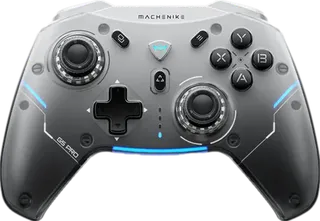
    Quick comparison: my boyfriend's EasySMX X05 Pro has Hall effect sticks and costs about the same, but its paddles are stiffer and the software is worse. The Machenike G5 Pro has a better finish and costs a good bit more. I paid R$ 329 on sale, with a 1-year warranty, and at that price with a Hall effect trigger, 4 profiles and a paddle, it's fair. Just don't expect Hall effect on the sticks
    Pros
    • Hall effect triggers with no noticeable dead zone
    • 4 profiles in memory, switch without PC
    • Paddles well positioned and easy to map
    • 3.5 mm jack recognized on Xbox and PC
    Cons
    • Built-in cable, not replaceable
    • Regular sticks, risk of drift later
    • No wireless option