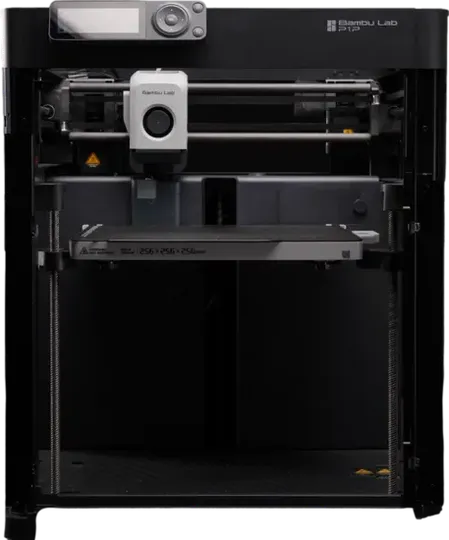
Bambu Lab P1P
7.5
3D printers

Bambu Lab P1P

Write a review
Compare
Key specs
  • 500 mm/s 3D print speed better than 74%
  • 256 × 256 × 256mm Max creation size better than 59%
  • 9650 g Weight better than 56%
Add to comparison

About the model

Bambu Lab P1P is a fused deposition modeling 3D printer released in 2022. It builds parts by laying down melted filament, reaching print speeds up to 500 mm/s, which shortens the time a model spends on the plate.

The 0.4 mm nozzle takes 1.75 mm filament in PLA, PET, ABS and PVA, and a heated platform with automatic and manual levelling keeps the first layer flat. Files in stl, obj and 3mf load from USB or over Wi-Fi, and printing resumes after a power cut.

Overview

Features
Materials
Components
Print sizes
Connectivity
General info
Why Bambu Lab P1P is better than average
  • Thickness
    389 mm
    better than 79%
  • Width
    386 mm
    better than 77%
  • 3D print speed
    500 mm/s
    better than 74%
All specifications

Often compared with

9.8
Compare
To favorites
9.4
Compare
To favorites
8.6
Compare
To favorites
8.5
Compare
To favorites
8.8
Compare
To favorites
7.4
Compare
To favorites
7.6
Compare
To favorites
7.8
Compare
To favorites
8.2
Compare
To favorites
7.2
Compare
To favorites

Bambu Lab P1P prices

Prices are updated daily and may differ from the shop. We may earn a commission from purchases.

General info

Specifications
File formats
3MF, OBJ, STL
Weight
9650 g
Fused deposition modeling (FDM) technology
Yes
Stereolithography (SLA) technology
No
Selective laser sintering (SLS) technology
No
Release date
5 Nov 2022
Height
458 mm
Width
386 mm
Thickness
389 mm
Volume
68770.5 cm³

Components

Specifications
Auto-generated support structures
No
Heated build platform
Yes
1.75mm filament diameter
Yes
Nozzle size
0.4 mm
3D print speed
500 mm/s
Number of extruder heads
1

Materials

Specifications
PET printing
Yes
Printing in PLA
Yes
Printing in HIPS
No
Printing in ABS plastic
Yes
Printing in PVA
Yes
Paper printing
No
Printing in wood
No

Print sizes

Specifications
Max creation size
256 × 256 × 256mm

Connectivity

Specifications
App control
Yes
External memory slot
Yes
USB ports
1
RJ45 ports
0
Wi-Fi connectivity
Yes
Wi-Fi version
Wi-Fi 4 (802.11n)

Features

Specifications
Integrated display
Yes
Screen size
2.7"
Touch screen
No
Bed levelling
Automatic bed leveling, Manual bed leveling
Power loss recovery
Yes
Pre-assembled
Yes
Operating power consumption
350 W

Owner reviews

Share your experience with Bambu Lab P1P! It takes a couple of minutes and helps others choose.
Reviews (1)
  • Vicente1
    10/10
    10/10
    • Value for money: 10/10
    • Ease of use: 9/10
    • Performance: 10/10
    • Reliability: 9/10
    • Build quality: 9/10
    Four years of Ender 3, an afternoon to put it together
    My Ender 3 turned four in January, and I sold it the same weekend this one showed up. I'll go in parts, since that's how I like reading this stuff when I'm trying to decide.

    Assembly: it came preassembled. Screw on the screen, take off the axis locks, tension the belts. From opening the box to the first Benchy was 40 minutes flat, wifi included.

    Speed: the spec says 500 mm/s and I'm not going to claim it always prints there, but with the generic PLA profile at 0.2 it's three times faster than my old i3. The same Benchy that used to take me 1h50 came out in 17 minutes and with better walls. That's the part I wasn't expecting.

    Leveling: actually automatic. I run it once a month from the app and that's it. It also has the manual paper mode if you like the ritual, but with the mesh it stores you don't touch it again.

    Power draw: 350 W with the bed at 60, measured with one of those plugs that shows watts. On a four-hour print it shows up on the bill as less than I thought.

    What I didn't like: no RJ45, only wifi 4, and in my flat the router doesn't reach the garage well, so sometimes I load files over microSD like it's 2019. The 2.7-inch screen feels cramped and 90% of the time I end up using the phone. And ABS: the spec says yes it does, but the P1P is open, and a big part cracked on me from the draft until I put on a temporary cardboard enclosure. With PLA and PETG, zero trouble, not one lifted corner.

    I compared it with the A1, cheaper but with a moving bed, and with the Prusa XL, which with two heads comes to four times the price. For one person printing functional parts at home, this is the math I ended up with.

    I paid 599 euros with shipping. I tested power-loss recovery by accident last month, the breaker tripped, and it carried on where it was. I'd buy it again tomorrow.
    Pros
    • Genuinely fast, not just on the spec sheet
    • Preassembled, ready in 40 minutes
    • Automatic leveling that works on its own
    • Price well below a Prusa
    Cons
    • No RJ45, wifi 4 only
    • Open frame: large ABS parts crack
    • Small 2.7-inch screen