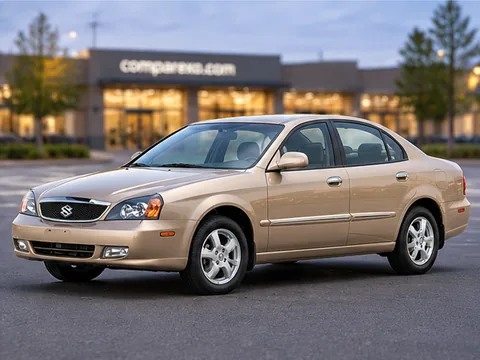
A Japanese company that started with looms
Suzuki is a Japanese manufacturer, incorporated in March 1920 under the name Suzuki Loom Manufacturing Co. Its documented head office is in Hamamatsu, Shizuoka. The corporate name changed twice as the business moved toward road vehicles: Suzuki Motor Co., Ltd. in June 1954, then Suzuki Motor Corporation in October 1990.
The company lists automobiles, motorcycles and outboard motors among its main products. That breadth is worth keeping in mind, because the cars form one branch of a much wider industrial portfolio rather than a stand-alone operation.
Production beyond Japan
Suzuki identifies Pak Suzuki as its subsidiary, and the company reported that this operation had reached two million cumulative automobile units by August 2018. Suzuki's own account of that production highlights models based on Japanese minicars, including the Alto and the Wagon R — a clear pointer to the small-car thinking that runs through much of the range.
The current line-up
The make counts 65 models in total, with 26 names in the current roster. The smallest end is well populated: Alto, Alto Lapin, S-Presso, Eeco, Wagon R and Wagon R Smile all sit there, alongside the Every and the electric e Every.
Above that, the Swift, Baleno and Fronx handle compact duties, while the S-Cross, Vitara and Grand Vitara cover crossover ground. The Jimny and Jimny Sierra keep a short-wheelbase, utility-focused option alive, and the XL7 and Ertiga add larger family transport. Electrification now has its own footing through the e Vitara and e Sky, and the tall-box kei tradition continues in the Spacia, Hustler, Xbee, Solio, Landy and Across.
Models worth remembering
The list of discontinued cars runs deep. The Carry Truck opens the record, while the Fronte (1962–1989) and the Cervo (1977–2009) trace the early small-car decades. The Samurai (1985–2003) and the Escudo (1988–2023) bookend nearly four decades of more utilitarian entries, and the Cappuccino (1991–1997) shows a lighter, sportier side of the same period.
More recent departures include the SX4 (2006–2021), the Kizashi (2009–2015), the Celerio (2014–2025), the Ignis (2000–2025) and the Ciaz (2015–2025); the Swace (2020–2025) closes another short chapter.
How owners rate the brand
Across the 5,887 trims that make up the range, owners give Suzuki an average rating of 8.4 out of 10. That score covers everything from city hatchbacks to off-roaders and the newest electric models, so it reads best as a general satisfaction signal rather than a verdict on one particular car.
Comparing within the brand is straightforward: settle the body size first, then the generation. A Jimny and a Swift share a badge and little else, while the transition from an older Ignis to a current model says more about how the range has been repositioned than any single specification sheet.
















































































































 Suzuki: all models, specs and prices


 Washing machines
 Fridges
 Robot vacuums
 Portable power stations
 Vacuum cleaners
 Air fryers
 Coffee machines
 Dishwashers
 Portable air conditioners
 Tumble dryers
 Pressure cookers
 Bean-to-cup coffee machines
 Commercial coffee machines
 Heat pumps
 Air purifiers
 Window air conditioners
 Washer dryers
 Split air conditioners
 Cassette air conditioners
 Air conditioners