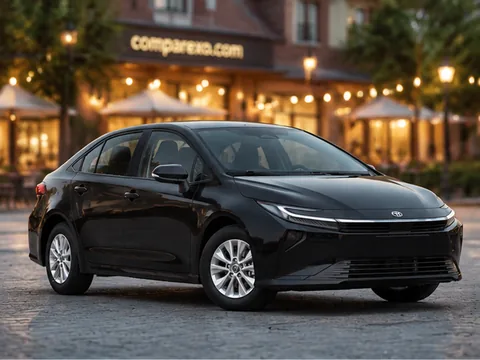
The model at a glance
The Subaru Levorg is a mid-size performance tourer, a station wagon built around five seats, horizontally opposed petrol engines and permanent all-wheel drive. Its identity sits between a practical estate and a sporty saloon: low load floor, long roof, and a body whose proportions read as a passenger car rather than an SUV.
The nameplate arrived in 2014 and is now in its second generation, offered in 84 trims and rated 9.1 out of 10 by 3,408 owners. Every version shares the same recipe — boxer engine, Lineartronic CVT and all-wheel drive — with outputs spanning 150–300 hp.
Generations and evolution
Subaru showed the Levorg prototype at the 2013 Tokyo Motor Show and opened Japanese pre-orders in January 2014, with the first-generation VM reaching customers that year. It was sold in Europe and Japan, shares its architecture with the Impreza, WRX and Legacy, and ran until 2020 with a single facelift. Owners of this generation rate it 9.1 out of 10.
The first-generation range grew from the 1.6GT and GT-S into the 2.0GT-S, and STI Sport joined the line-up in 2016. Demand was strong enough that Subaru reported brisk sales of the wagon in 2015, helped by a shape that carried estate volume without the height penalty of a crossover.
The second-generation VN appeared as a prototype in 2019 and went on sale in Japan in 2020, moving to the Subaru Global Platform with full inner-frame construction. Launch grades were GT, GT-H and STI Sport, with EyeSight and EX option packs; EyeSight pairs stereo cameras with four radars, and EyeSight X is offered in Japan. The VN won 2020–2021 Car of the Year Japan — Subaru's third such award — and drew 12,594 orders by 6 December 2020 against a 2,200-unit monthly target. Its owner rating of 9.4 out of 10 is the highest in the range. Production is documented at Subaru's Gunma Main Plant in Ota, Japan.
Engines, performance and efficiency
Power comes from boxer petrol engines of 1.6–2.4 L, driving all four wheels through a CVT. The spread runs from 150 hp to 300 hp, enough for 0–100 km/h in 8.9–11.7 s and a top speed of 195–210 km/h. Consumption of 5.7–9.1 l/100 km reflects the gap between the smaller turbo units and the tuned flagships.
The VN launched with a 1.8-litre CB18 direct-injection turbo boxer, and the STI Sport R added a 2.4-litre FA24F turbo in 2021 for the sharpest tune in the line. Japan-market special editions include the V-Sport and the STI Sport R-Black Limited, with grade names and equipment varying by market.
Practicality and dimensions
The wagon body measures 4690–4755 mm long and carries five people, with a boot of 522–561 l depending on version. That load bay is the reason the model exists: it swallows family luggage while the roofline stays low enough to keep the centre of gravity and the driving position car-like.
Rivals and who it suits
Cross-shopping usually starts with the Subaru Impreza and Outback, the Toyota Corolla and Corolla Fielder, the Honda Civic and Jade, the Toyota Mark X and the Subaru Forester. Against saloons such as the Civic or Mark X the Levorg trades boot shape for volume; against the Forester it trades ground clearance for steering feel.
It suits drivers who want estate usefulness with a turbocharged flat-four and all-wheel drive, and who value a low, stable stance over a high seating position. Buyers comparing generations should weigh the VM's wider engine choice and European availability against the VN's stiffer global platform, newer 1.8-litre turbo and more advanced EyeSight assistance.


















































































































 Washing machines
 Fridges
 Robot vacuums
 Portable power stations
 Vacuum cleaners
 Air fryers
 Coffee machines
 Dishwashers
 Portable air conditioners
 Tumble dryers
 Pressure cookers
 Bean-to-cup coffee machines
 Commercial coffee machines
 Heat pumps
 Air purifiers
 Window air conditioners
 Washer dryers
 Split air conditioners
 Cassette air conditioners
 Air conditioners