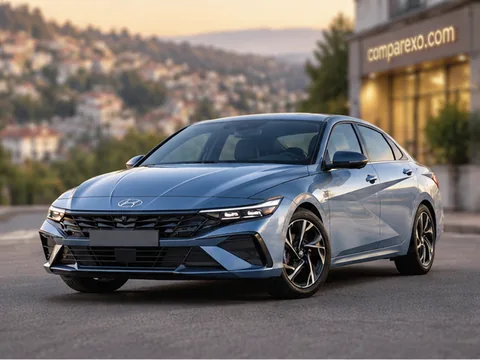
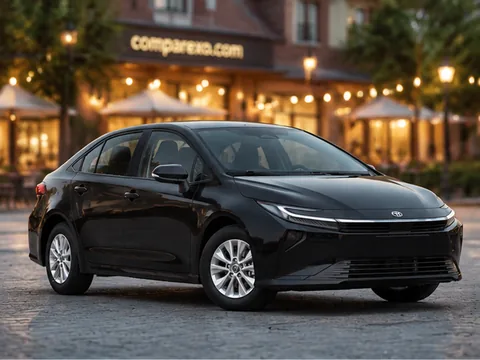
The model at a glance
The MG 5 is a compact family car sold as a five-door hatchback and, in later form, a four-door saloon. SAIC positioned it in the C-segment as an affordable family model, and it has been built in three generations since 2012. Across the range the catalog lists 46 trims, all powered by 1.5-litre petrol engines driving the front wheels, with a body length spanning 4363–4715 mm.
Owners rate the model 8.6 out of 10, a score that fits its role as straightforward transport rather than a driver's machine. Five seats, a boot between 327 l and 512 l and consumption in the 5.6–7.8 l/100 km band explain much of the appeal.
Generations and evolution
The story opens with the MG Concept 5, shown at the 2011 Shanghai Auto Show, and the production car that followed on 28 March 2012. That first generation, coded AP12, was a five-door hatchback on the Roewe 350 platform, continuing the line of the MG ZR and Rover 25. It ran from 2012 to 2018 and was exported to markets such as Egypt, Chile and Algeria, while the saloon of that era sold in China as the MG GT; from 2019 the MG 5 badge was also applied abroad to a rebadged Roewe i5 saloon.
Generation 2, the AP32, debuted in September 2020 ahead of the Beijing Auto Show as a larger saloon on the PATAC K platform, and it is the version that travelled furthest, reaching Thailand, Mexico and Australia between 2021 and 2023. A facelift unveiled on 14 August 2024 brought new front and rear styling plus a digital cockpit, and it is this revised car that sources treat as the current third iteration, listed for the Russian market from 2023.
Assembly has run at SAIC's Pukou plant in Nanjing and, for the saloon, at Laem Chabang in Thailand through SAIC-CP, with local Egyptian production announced in late 2024.
Engines, performance and efficiency
Every MG 5 in the catalog uses a 1.5-litre petrol engine, sending drive to the front wheels through a manual, CVT, automated manual or automatic gearbox. Output spans 109–181 hp, which translates to a top speed of 170–200 km/h and combined consumption of 5.6–7.8 l/100 km.
The second-generation range splits into a 1.5 naturally aspirated unit of 120 PS and a 1.5 turbo of 173 PS, the latter raised to 181 PS and 285 Nm in the Scorpio variant of 2022, which pairs a seven-speed dual-clutch gearbox with a 200 km/h top speed and a longer body. The MG 5 EV sits apart from the petrol cars: an electric estate built on the Roewe Ei5, launched in the UK in September 2020 with a 52.2 kWh battery and 214 mi of WLTP range, followed in 2021 by a 61.1 kWh Long Range version rated at 400 km WLTP and 156–184 PS.
Practicality and dimensions
Body style sets the footprint. The hatchback measures 4363 mm, while the later saloons stretch to 4715 mm, always with seating for five. Luggage capacity runs from 327 l to 512 l, so the hatchback and the electric estate answer quite different needs despite sharing a nameplate.
Which version to compare
Three generations, 46 trims and two body styles make the MG 5 a model where the generation matters more than the badge. The AP12 hatchback is the compact, older option; the AP32 saloon and its 2024 facelift are the modern, widely exported cars; the Scorpio brings the strongest petrol drivetrain with 181 hp.
Safety is worth checking version by version: ANCAP rated the Australian-market MG 5 zero stars in 2023, citing missing seatbelt pre-tensioners and limited automatic emergency braking, and MG announced a $4 million upgrade for Australia in 2024. For emission-free driving, the MG 5 EV is the alternative inside the same range.


















































































































 Washing machines
 Fridges
 Robot vacuums
 Portable power stations
 Vacuum cleaners
 Air fryers
 Coffee machines
 Dishwashers
 Portable air conditioners
 Tumble dryers
 Pressure cookers
 Bean-to-cup coffee machines
 Commercial coffee machines
 Heat pumps
 Air purifiers
 Window air conditioners
 Washer dryers
 Split air conditioners
 Cassette air conditioners
 Air conditioners