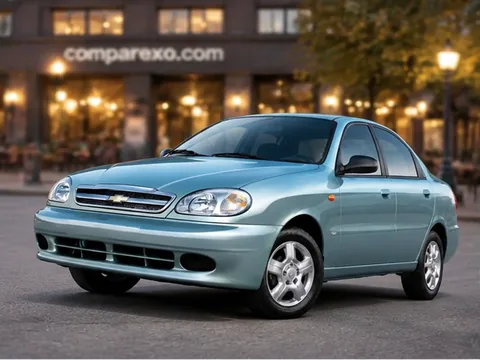
The model at a glance
The Daewoo Lanos is a subcompact small-family passenger car built in three body styles: a three-door hatchback, a five-door hatchback and a four-door sedan. It carries five seats, drives the front wheels and sits in the passenger cars segment, a position that placed it among the most accessible family cars of its era rather than among performance machines.
Owners rate the model 7.9 out of 10 across 1249 votes, a solid score for a car whose strengths lie in simplicity and running costs rather than in sophistication. The catalog lists 45 trim variants, spread across a single generation and a long production life in several markets.
A single generation, built in many countries
The Lanos is catalogued as one generation, the T100, sold in Europe and the USA between 1997 and 2009 and updated once during that run. Work on the programme started in autumn 1993, when Daewoo set out to replace the Nexia with a car of its own design. Giugiaro’s proposal was chosen, and the model was launched in South Korea in November 1996.
The first Korean car was a four-door sedan with a 1.5-litre engine; a 1.3-litre option and the three- and five-door hatchbacks followed in 1997, the same year European-market production began. Korean assembly at the Bupyeong plant ended in 2002, after which licensed and CKD production continued elsewhere — at FSO in Warsaw, ZAZ in Ukraine, TagAZ in Russia, Daewoo Motors Egypt in Cairo and GM Egypt in 6th of October City, and VIDAMCO in Vietnam.
That long second life mattered commercially. The Lanos was Ukraine’s best-selling car from at least 2006 through 2014, every year except 2012, with 364,000 cars bought there over the period reported.
The 2000 update and the trim range
The facelift introduced around 2000 revised the front end and the interior, redesigned the sedan’s rear and taillights, and was marketed in Korea as the Lanos II, or T150. Original trim levels ran from S through SE and SE Plus to SX, while the 2001–2002 SPORT replaced SE and SX in the later years and brought red or black leather seats with metallic-silver dash trim.
Korean hatchbacks carried their own names: the three-door was the Lanos Romeo, the five-door the Juliet — a badge also used for the five-door in Egypt. Underneath, the car used a front-engine, front-wheel-drive layout on the GM T front-drive platform, with suspension derived from the Nexia and, in turn, the Opel Kadett E.
Engines, performance and efficiency
Power came from E-TEC inline-four petrol engines of 1.3, 1.5 and 1.6 litres, producing between 70 and 110 hp. Buyers could choose a manual gearbox or an automatic, the four-speed unit appearing in some versions. Acceleration from 0 to 100 km/h takes 11.5 to 17 s depending on the engine, and top speed ranges from 160 to 180 km/h.
Fuel consumption sits between 5.6 and 8.9 l/100 km. The 1.6 DOHC version was the most thoroughly engineered of the range, with larger front brakes, a transmission with a different ratio and stiffer front springs.
Practicality and dimensions
The Lanos measures 4074 to 4237 mm in length depending on body style, which keeps it manageable in town while still offering five seats. Trunk volume runs from 250 to 322 l, the hatchbacks trading some of the sedan’s load space for a taller opening and more flexible use of the rear cabin.
Rivals and who it suits
Cross-shopping usually starts with the Chevrolet Lanos, the same car under a different badge, and the Daewoo Nexia it was designed to replace. Buyers also weigh the Лада 2110 and Лада Приора, the Geely MK and the Chevrolet Aveo, with the Daewoo Leganza and Opel Omega appearing as larger alternatives for those who need more room.
The Lanos suits drivers who want a compact, mechanically straightforward petrol car with cheap upkeep and parts widely understood by independent workshops. Its appeal rests on the breadth of the 45-trim range and the fact that the same design was built and kept alive across Europe for more than a decade.


















































































































 Washing machines
 Fridges
 Robot vacuums
 Portable power stations
 Vacuum cleaners
 Air fryers
 Coffee machines
 Dishwashers
 Portable air conditioners
 Tumble dryers
 Pressure cookers
 Bean-to-cup coffee machines
 Commercial coffee machines
 Heat pumps
 Air purifiers
 Window air conditioners
 Washer dryers
 Split air conditioners
 Cassette air conditioners
 Air conditioners